Sustainable rented house: best practices of Ichiani Villa
Wednesday, April 28, 2021
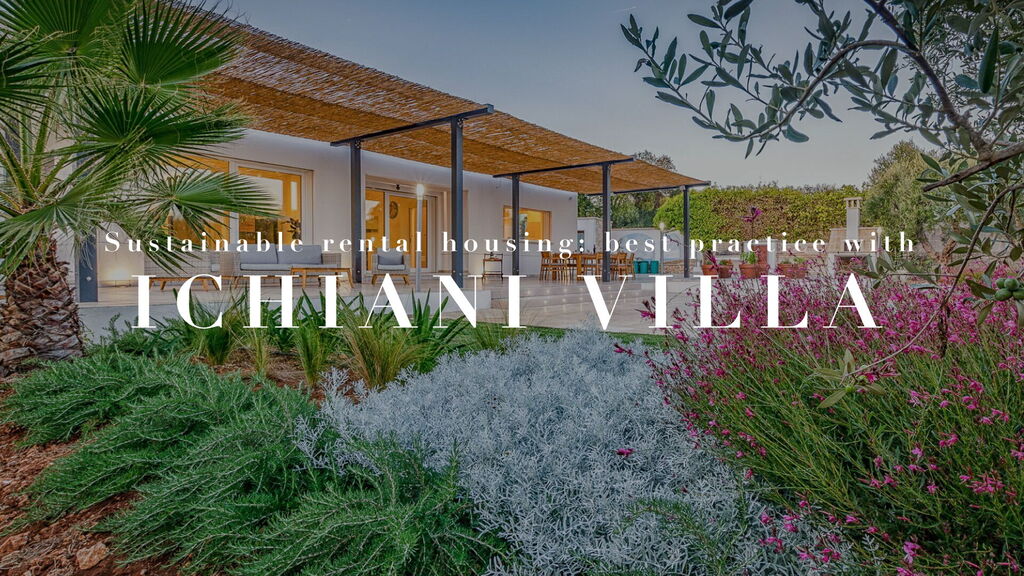
A sustainable rental house: best practice with Ichiani Villa
The collective awareness of the impact that our standard of living is having on the Earth has led to an increasingly critical view of building for tourism and other purposes; in particular, the construction of a holiday rental home today needs to combine comfort and sustainability in a welcoming space centred on the needs of both the individual and the community, thus delineating the concept of a "sustainable rental home".
The focus on climate change and the horrors that have been wrought over the years has meant that a group, fortunately an increasingly large one, of people who are attentive and sensitive to the subject have become more and more vocal about what needs to be changed in order to be respectful of the planet, resulting in a series of best practices in almost all contexts (tourism and otherwise).
In concrete terms, when we talk about best practice for sustainable rental housing, we are referring to a method of construction and design choices that blend well with the surrounding environment and allow the exploitation of resources to optimise results while reducing waste.
For example, since 2014, the construction of houses according to the rules of green building has increased significantly, bringing Italy to 4th place in Europe; in fact, as investors/customers have greatly increased the demand for zero impact properties, real estate and tourism trends have necessarily shifted the focus on conscious and sustainable choices.
The best practice for building a sustainable rental house with a very low environmental impact should therefore include a number of measures, such as:
- Conscious choice of materials used: it is necessary to use materials that are not only green but also have an adequate lifespan and, above all, are safe for the environment and for those who live there.
- Insulation: the main focus of sustainable construction is to reduce heat loss almost completely, thus guaranteeing a minimum use of energy to heat or cool the home.
- Correct exposure of the house: in order for the insulation to work, it is necessary to assess the correct exposure of the house, thus improving energy efficiency; the most recommended choice is a southern exposure of at least 30%, in order to optimise the heat coming from the sun in winter, while limiting overheating in summer.
- Use of renewable energies: the green choice passes, above all, through the use of renewable energies; an example is certainly the photovoltaic panels that are increasingly present in modern buildings.
In terms of tourism, one of the houses most in line with the idea of sustainable building is certainly Ichiani Villa, to date the only villa in Puglia to have won the Smart Building award in 2017.
The house has been awarded KlimaHouse Gold certification by the South Tyrol Energy Agency - ClimateHouse of Bolzano and features a number of green innovations that are well matched to the needs and comforts of a prestigious villa.
First of all, all the windows and door frames were replaced with certified frames, and adjustable solar shading systems were installed which can be adjusted using domotic technology, limiting overheating to a minimum. A photovoltaic system and a solar thermal system were also built, arranged so as not to affect the aesthetics of the building but still guaranteeing important performance for the house's functionality.
Lastly, Ichiani Villa's special feature is the energy requalification of the existing shell, using Ytong's Multipor insulation panels (made only from natural mineral materials): thanks to the high thermal inertia developed by this system, it is possible to save energy in both winter and summer, keeping the rooms at a constant temperature all year round.
In conclusion, the universal direction towards a more sustainable life also passes through green building, which, with green materials and interventions aimed at an intelligent and low-impact exploitation of resources, allows us to live for long or short periods (as in rented houses) in environments that can listen to both the needs of the individual and those of the community and, therefore, of the Planet.
- Conscious choice of materials used: it is necessary to use materials that are not only green but also have an adequate lifespan and, above all, are safe for the environment and for those who live there.
- Insulation: the main focus of sustainable construction is to reduce heat loss almost completely, thus guaranteeing a minimum use of energy to heat or cool the home.
- Correct exposure of the house: in order for the insulation to work, it is necessary to assess the correct exposure of the house, thus improving energy efficiency; the most recommended choice is a southern exposure of at least 30%, in order to optimise the heat coming from the sun in winter, while limiting overheating in summer.
- Use of renewable energies: the green choice passes, above all, through the use of renewable energies; an example is certainly the photovoltaic panels that are increasingly present in modern buildings.
In terms of tourism, one of the houses most in line with the idea of sustainable building is certainly Ichiani Villa, to date the only villa in Puglia to have won the Smart Building award in 2017.
The house has been awarded KlimaHouse Gold certification by the South Tyrol Energy Agency - ClimateHouse of Bolzano and features a number of green innovations that are well matched to the needs and comforts of a prestigious villa.
First of all, all the windows and door frames were replaced with certified frames, and adjustable solar shading systems were installed which can be adjusted using domotic technology, limiting overheating to a minimum. A photovoltaic system and a solar thermal system were also built, arranged so as not to affect the aesthetics of the building but still guaranteeing important performance for the house's functionality.
Lastly, Ichiani Villa's special feature is the energy requalification of the existing shell, using Ytong's Multipor insulation panels (made only from natural mineral materials): thanks to the high thermal inertia developed by this system, it is possible to save energy in both winter and summer, keeping the rooms at a constant temperature all year round.
In conclusion, the universal direction towards a more sustainable life also passes through green building, which, with green materials and interventions aimed at an intelligent and low-impact exploitation of resources, allows us to live for long or short periods (as in rented houses) in environments that can listen to both the needs of the individual and those of the community and, therefore, of the Planet.