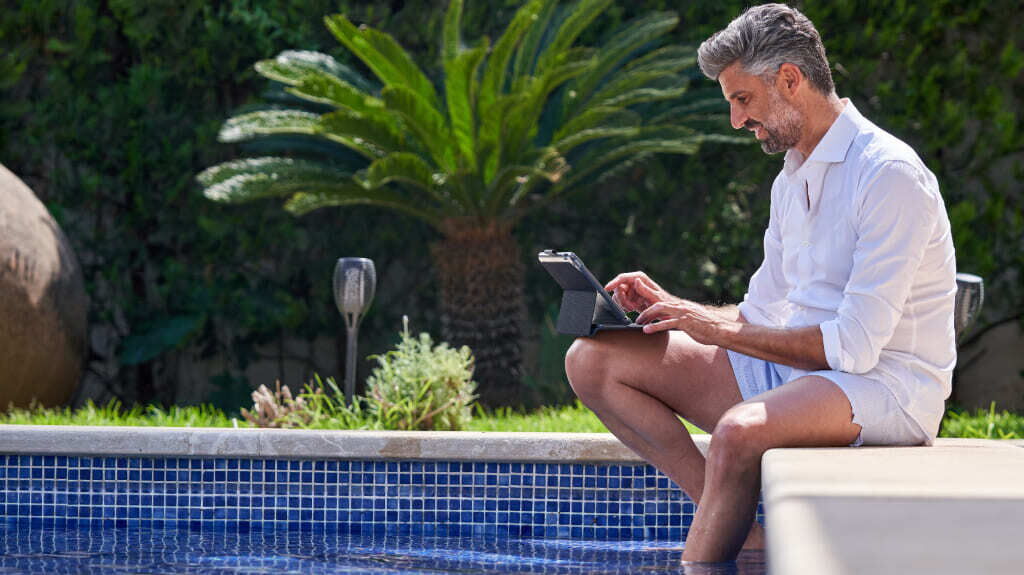
How to organise a workation in Italy without giving up comfort and privacy?
Navigate the article:
- What makes a villa suitable for a workation: the criteria that actually matter
- The best Italian destinations for a villa workation
- The Raro Villas properties best suited to a workation: a concrete selection
- How to structure the days: the method that works
The workation in 2026 is no longer an emerging trend: it is a structured reality. 67% of business travellers extended at least one business trip for personal travel in 2025, up from 43% in 2022. The boundary between holiday and remote work has dissolved for millions of professionals worldwide. The phenomenon no longer concerns only freelancers and digital nomads: it concerns managers, lawyers, consultants, creatives, anyone whose only real work tools are a laptop and a connection.
The problem is that a quality workation, one that genuinely allows you to work well and relax equally well, requires a type of accommodation that coworking spaces and hotels cannot fully provide: a private, quiet base with separate work and living spaces, reliable Wi-Fi and a context that does not distract at the wrong moments. For discerning, high-net-worth travellers, a private villa in Italy is the most natural fit for this kind of getaway.
Raro Villas features a selection of estates that align perfectly with this vision: residences with confirmed connectivity, spacious interiors, outdoor areas where you can work in the open air or switch off completely, and sufficient distance from urban centres to guarantee quiet during working hours. This guide explains how to organise a workation in Italy without compromise.
What makes a villa suitable for a workation: the criteria that actually matter
Not all villas are equal from a workation perspective. A romantic villa for a couple on honeymoon and a villa suitable for a professional who needs to join international calls every morning have very different requirements. Before choosing, there are four concrete variables to verify.
The first is connectivity: Wi-Fi present is different from Wi-Fi reliable enough for video calls. In Italy, fibre coverage in rural areas has improved significantly in recent years, especially in Puglia and Tuscany, but it remains a variable to verify before booking. Raro Villas provides this information for all properties and the team can check connection speed on request before booking.
The second is space separation: a villa with a single shared living area works for holidays, not for a mixed-group workation where some work and others relax. Properties with multiple spaces, dedicated rooms or independent annexes are ideal.
The third is the acoustic context: a villa in a tourist village with summer traffic is very different from a masseria immersed in the Pugliese countryside three kilometres from the nearest town. For a workation, quiet mornings during working hours are a non-negotiable requirement, not an optional luxury.
The fourth is the minimum stay duration: many properties accept weekly or bi-weekly stays, ideal for a structured workation. The Raro Villas team can negotiate longer durations on request for professionals seeking a base for 2 to 4 weeks.
The best Italian destinations for a villa workation
Not all Raro Villas destinations are equally suited to a workation. The choice depends on the type of professional, the season and the balance sought between work and leisure.
Puglia, particularly the Valle d'Itria and the Ostuni area, is the most balanced destination for a workation: the climate is excellent from March to October, connectivity in prestigious residential areas is reliable, and the distance from urban centres guarantees quiet without isolation. Restored masserias and trulli offer spacious, well-lit interiors perfect for morning work and territory exploration in the afternoon.
Tuscany—particularly Montalcino and Chianti—is the natural choice for those seeking a rich cultural backdrop and a landscape that fosters focus: rolling hills, quiet vineyards, and serene silence. It’s ideal for mid-length stays of 10 to 21 days during the shoulder season.
Sardinia, particularly in the Arzachena and Porto Cervo area, offers a different balance: work in the morning, sea in the afternoon. The most suitable period for a Sardinian workation is September, when property connectivity is fully operational, the sea is at its peak temperature and beaches have shed August's tourist pressure.
- Puglia, Valle d'Itria and Ostuni: ideal from March to October, guaranteed quiet, properties with multiple spaces
- Tuscany, Montalcino and Chianti: ideal from April to November, inspirational landscape, farmhouses with ample interiors
- Sardinia, Arzachena and Porto Cervo: ideal in September, warmest sea of the year, villas with panoramic terraces
- Salento, Lecce and surroundings: ideal for those who value urban energy close by, with the countryside as a private base
Read also: Puglia or Sardinia? How to choose the right destination for your exclusive villa holiday
The Raro Villas properties best suited to a workation: a concrete selection
Corte Kalia in Puglia is perhaps the Raro Villas portfolio property that best expresses the concept of a high-quality workation: restored trulli and villa with infinity pool, golf area with outdoor putting green and indoor Trackman simulator, included Wi-Fi, well-differentiated indoor and outdoor spaces, and 5 bedrooms for 10 to 12 guests. For teams looking to blend high productivity with wellness, it offers everything they could possibly need.
Tenuta Palù in Carovigno is a luxury villa with indoor and outdoor pool, lush gardens, 4 double bedrooms each with private bathroom, an independent annexe with heated indoor pool, alarm system and high-speed Wi-Fi across the entire property. The position, a short distance from the centre of Carovigno and 15 minutes from the Torre Guaceto natural reserve, guarantees access to services without sacrificing operational privacy.
Villa Ambrosini in Montalcino is the Raro Villas reference for the Tuscan workation: a stone villa with air conditioning, private pool and Wi-Fi, 6 bedrooms for 12 guests with a large ground-floor communal living area. The option of having a professional chef in the villa removes meal management during the most intensive working days, and the position in the Montalcino vineyards guarantees silence of exceptional quality.
Masseria Borgopietra in Ostuni, with 7 bedrooms, pool and 4 hectares of olive trees, is the choice for larger teams or extended families where only part of the group works remotely: the spaces are large enough to guarantee real separation between work and leisure areas.
For those travelling as a couple or alone and looking for a more intimate but equally curated base, Villa Amelia in Ostuni is a modern villa with an infinity pool, panoramic views over the Valle d'Itria, air conditioning and Wi-Fi in all spaces including the terrace, with utilities included in the price.
How to structure the days: the method that works
A workation almost always fails for the same reason: not having defined the temporal boundaries between work and holiday before leaving. Landscape and climate alone are not enough to guarantee productivity if the daily structure is left to improvisation.
The model that works best, confirmed by those who practise it regularly, is a three-block division:
- Morning (7:00-13:00): protected working hours in a dedicated space in the villa, with non-work notifications silenced. The outdoor terraces of Pugliese masserias in the morning hours, with raking natural light and absolute quiet, are among the most productive working environments Italy can offer.
- Early afternoon (13:00-15:30): lunch prepared by an in-villa chef or with produce from the morning's local market, a genuine device-free break.
- Afternoon and evening (15:30 onwards): pool, excursion, dinner out, exploration of the territory. Time completely free from any professional commitment.
This structure allows a full working week to be completed in five days, with Friday and the weekend dedicated entirely to the experience of the place.
To build a workation in Raro Villas destinations, including connectivity verification before booking and the organisation of additional services (chef, transfers, activities), the team is available via the contact form.
Read also: Golf, padel and sailing: how sport is changing the way people choose a villa in Italy
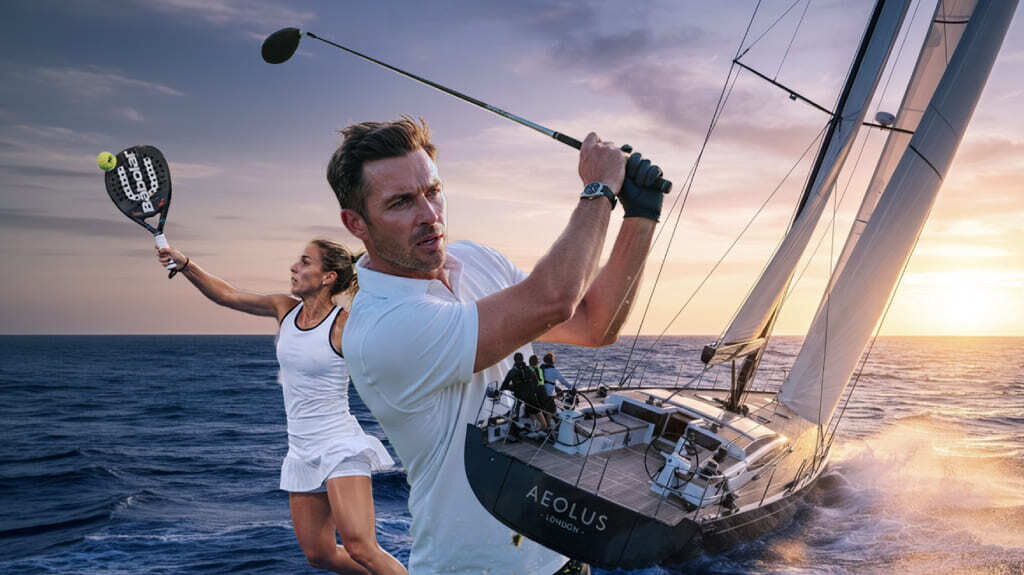
Golf, padel and sailing: how sport is changing the way people choose a villa in Italy
Explore the article:
- Golf: from private practice to the 18-hole course in Porto Cervo
- Padel: the sport of the moment enters villas and proximity facilities
- Sailing and Water Sports: When the Sea Is Part of the Villa
- Why sport is becoming a primary selection criterion for villa holidays
There’s a single metric that captures today’s evolution in high-end travel: affluent guests want far more than a private villa with a pool. They are looking for a villa that allows them to continue practising the sport that is part of their identity, without sacrificing the comfort of a private residence. Golf, padel and sailing are the three languages through which this change is expressing itself most forcefully.
Padel today counts over 35 million players worldwide, with courts growing by more than 15% in a single year to exceed 77,000 globally. Europe concentrates over 60% of players and about two-thirds of all courts in the world. Golf is living a new season of interest, driven by a younger and more international audience that combines it with quality accommodation experiences. Sailing, particularly in its more accessible form with catamarans and charter boats, has become an integral part of the premium coastal destination offer. Three sports, one common denominator: the search for active experiences within a holiday that never compromises on the quality of the residence.
Raro Villas curates some of Italy’s finest residences for guests looking to experience the country on a deeper level. Here is a verified selection, with sporting activities within the property or in the immediate vicinity.
Golf: from private practice to the 18-hole course in Porto Cervo
Golf was the first sport to structurally intertwine itself with the concept of a luxury villa. It is no coincidence that some of the most sought-after structures in the Raro Villas catalogue have made private sports practice a defining feature.
Corte Kalia is the most sophisticated example of this integration in contemporary Puglia: a complex of restored trulli and villa immersed in the Pugliese countryside, with an infinity pool, that includes a golf area with an outdoor putting green and an indoor Trackman simulator. The Trackman simulator is the same tool used by professionals on the world tour to analyse their swing: golf academy technology, available exclusively for the villa's guests. Corte Kalia accommodates up to 12 guests in 5 bedrooms and sits in a strategic position for reaching the Valle d'Itria villages and the Salento beaches.
Masseria Ficalindia, in the Lizzanello countryside just minutes from Lecce, offers a private-use golf practice area on a 4.5-hectare property immersed in the Salento countryside. The masseria has 5 en-suite bedrooms and a billiard room, for an integrated experience of sport, nature and culture: Lecce is 14 minutes away, the Adriatic beaches 21 minutes.
In Sardinia, the absolute reference for golf is Villa Pevero in Porto Cervo: an exclusive villa with pool and sea views, minutes from the 18-hole Pevero Golf Club, one of the most celebrated and scenic courses in the Mediterranean, designed by Robert Trent Jones on a landscape of pink granite, Mediterranean scrub and views over the Gulf of Pevero. For those who want to combine golf and the Costa Smeralda in the same stay, this is the most direct answer.
Read also: Puglia or Sardinia? How to choose the right destination for your exclusive villa holiday
Padel: the sport of the moment enters villas and proximity facilities
Padel is everywhere in 2026. This racquet sport has broken down the barriers for entry and accessibility to take over the world in a rally of fitness, fun and new communities. For decades, high-end sports travel was ruled by golf and tennis. However, the rise of luxury padel retreats at resorts across the globe is becoming hard to ignore.
What makes padel such a natural fit for private is the compactness of the infrastructure required: a padel court needs far less space than a tennis court and can be integrated even into medium-sized properties. Several Raro Villas properties are in the immediate vicinity of facilities with dedicated courts.
The most relevant case in the Fasano area is Borgo Egnazia, the reference resort for luxury Pugliese hospitality, which features three padel courts where guests can challenge their chosen opponent or book private lessons with expert instructors, ideal for both enthusiasts and those trying the sport for the first time. Raro Villas properties in the Fasano, Carovigno and Savelletri area have direct access to this sporting offer within a few kilometres.
For guests seeking an on-site padel court, Raro Villas can organise through its concierge service the booking of courts at the facilities closest to the chosen villa, curating a custom match schedule throughout the stay. It’s this level of service that transforms a villa holiday from a simple getaway into a bespoke active retreat.
Sailing and Water Sports: When the Sea Is Part of the Villa
Sailing is the third sporting pillar that is reshaping how travellers choose a villa in Italy. It does not necessarily mean owning a boat: it means having access to a reachable sea, to a property that can organise catamaran or motorboat hire, and to coves that in high season are accessible only by water.
In this context, Villa Vega at Portobello di Gallura is the Raro Villas property that best expresses this integration: two independent villas for 20 guests, with exclusive access to 3 km of coastline with white sand coves and catamaran service on request, alongside private chef, transfers and luxury car hire. The catamaran is not optional: it is the means by which guests reach the Portobello peninsula's coves that have no road access, some of the finest in the Gallura.
Every September, the Costa Smeralda hosts the Sardinia Cup, the international sailing regatta that transforms Porto Cervo into one of the most exclusive nautical settings in the Mediterranean. Those staying in a Raro Villas property in the area during that period experience the event from the inside, not as an outside spectator. Villa Essenza at Porto Rafael, with a panoramic view over the gulf and the La Maddalena islands, is one of the finest bases for exploring these waters: a seawater pool in panoramic position, equipped terraces, a 2,000 sqm garden, just 4 km from Palau and its port with connections to the archipelago.
Read also: What are the best alternatives to the Costa Smeralda? 5 lesser-known destinations in Sardinia
Why sport is becoming a primary selection criterion for villa holidays
The data driving this shift is clear: the profile of the luxury traveler has fundamentally changed. Those who choose a private villa today are often between 35 and 55, practise sport regularly, and consider the ability to play padel, get a round of golf in or take a catamaran not an optional extra but a necessary condition for choosing the property.
This has direct consequences for how properties are selected: a villa with a private putting green or with guaranteed access to a golf course within five minutes is worth, in the market's perception, significantly more than an equivalent villa without this feature. The same applies to padel and sailing.
- Golf: regular practice requires continuity: a Trackman simulator in the villa or an 18-hole course five minutes away are both decisive arguments.
- Padel: the social sport par excellence, it lends itself perfectly to a group holiday. The availability of a court nearby becomes a selection criterion on par with the outdoor kitchen or sea view.
- Sailing and water sports: the destination matters as much as the property. A villa with an included catamaran or direct sea access opens up experiences that a villa without this service simply cannot offer.
To build a stay that integrates sport and a prestigious residence in Raro Villas' Puglia and Sardinia destinations, the team is available via the contact page for a personalised proposal that includes the planning of the sporting activity alongside the choice of property.
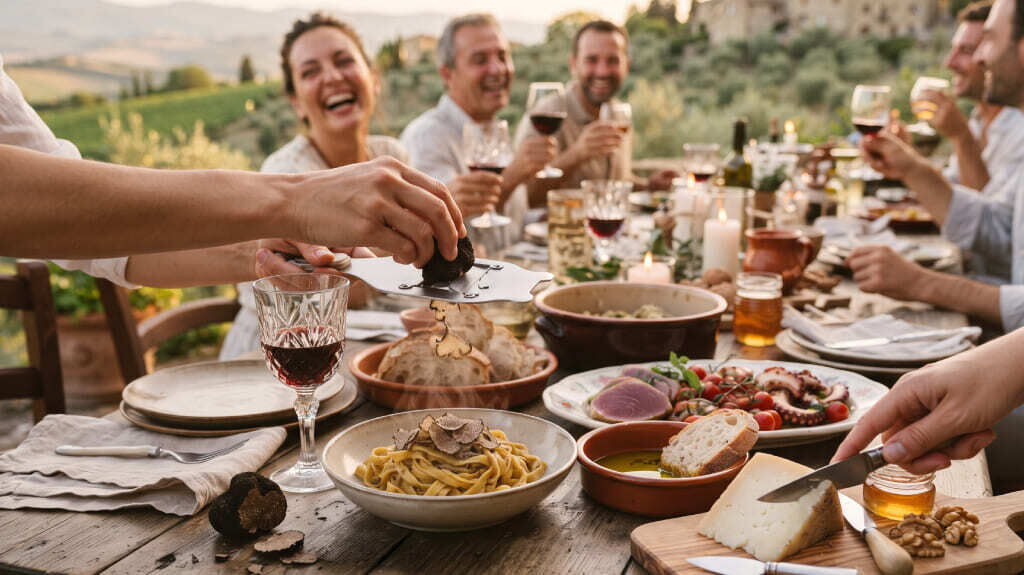
From the Brunello harvest in Tuscany to the tonnare in Sicily: 8 Italian gastronomic experiences to live at least once
Navigate the article:
- The Brunello harvest in Montalcino, Tuscany
- The "tonnare of Favignana" and Marzamemi, Sicily
- Black truffle hunting in Umbria
- Olive pressing at an Apulian oil mill
- Brunello and Nobile cellar tasting in Tuscany
- Sardinian pecorino and the cheese-making tradition
- An apulian cooking class in a masseria
- The dawn fish market in Gallipoli or Trapani
Italian food is not truly understood if consumed only in restaurants. It is understood when you enter a vineyard during harvest and pick the grapes that will become Brunello, when you walk through a tonnara's warehouses and grasp why Favignana transformed canned tuna in olive oil into one of the great inventions of modern food preservation, when you taste extra-virgin olive oil freshly pressed for the first time, still green and peppery in the throat. These are experiences that change the way you eat for the rest of your life.
The characteristic common to all eight experiences in this list is one: they are best lived from a private estate. A villa, a masseria, a farmhouse. A place that is yours for a week, where you can return in the evening after spending the afternoon in a winery, your nose full of grape marc and your head full of what you have learnt. Raro Villas has properties in the territories where these experiences are found, and this guide connects them.
1. The Brunello harvest in Montalcino, Tuscany
September and October in Montalcino are unlike any other time of year. The air smells of must, the vineyards surrounding the medieval hilltop town in the Sienese hills change colour within days, and in the Brunello cellars, one of the world's most celebrated and long-lived red wines, one of those moments is lived that producers wait 365 days to witness.
The tourist harvest in Montalcino allows participation in the picking, learning to taste the grapes to understand the real meaning of "ripe" by distinguishing skin, pulp and seeds, and witnessing the first stages of vinification. Structured experiences typically include lunch in the cellar, a visit to the barriques and a tasting of an already-released Brunello compared with the new wine. A before and after that few people forget.
Villa Ambrosini in Montalcino is the ideal base for this experience: a prestigious villa with a pool immersed in the vineyards, with the option of a professional chef in the villa and a housekeeper for meal preparation, minutes from the area's most important cellars.
2. The "tonnare of Favignana" and Marzamemi, Sicily
The tonnara is one of Sicily’s most profound cultural and architectural landmarks—and one that can only be fully appreciated in person. In Favignana, in the Egadi archipelago, the former Florio Stabilimento delle tonnare di Favignana e Formica is today a museum that narrates how Vincenzo Florio, in 1841, invented here the method of preserving tuna in olive oil, transforming an island into one of the most important industrial sites of nineteenth-century Sicily.
In Marzamemi, in the south-east of Sicily, the tonnara stands at the centre of one of the island's most photographed fishing villages. The large central square, the tonnara warehouses, the fishermen's cottages and the village’s tuna-curing tradition lives on in its local artisan food shops. Combining both tonnare in a single Sicilian itinerary allows one to understand how this tradition expressed itself in different ways in the island's north-west and south-east.
Villa Smeraldo at Verdura Resort in Sciacca, Sicily, is a private sea-front villa with three bedrooms at the heart of the Rocco Forte resort, the perfect base for exploring the tonnare and the western Sicilian coast.
3. Black truffle hunting in Umbria
Umbria is the Italian region where the black truffle of Norcia and Spoleto has its true homeland. The winter black truffle season runs from December to March, but the summer black truffle (scorzone) is available from June to September, making this experience possible even in the warm season. Truffle hunting with the dog is one of the most requested gastronomic experiences in Italian experiential tourism: you follow the truffle hunter and his truffle dog through oak and hornbeam woods, learn to recognise the signs that indicate the presence of the underground fungus, and finish with a tasting of the same truffles found, grated over fresh pasta or scrambled eggs.
Raro Villas has a selection of villas in Umbria among the hills of Perugia and Trasimeno, from which the truffle areas of Norcia, Spoleto and Cascia can be reached in under an hour. For those who want to combine black truffle, Sagrantino di Montefalco and an Umbrian country farmhouse, this is the most authentic combination that central Italy can offer.
4. Olive pressing at a Pugliese oil mill
Apulian extra-virgin olive oil is among the world's finest by both quantity produced and quality. Olive pressing, the extraction of oil from freshly harvested olives, takes place between October and December, and is one of those spectacles that permanently changes the way you use olive oil in the kitchen.
Puglia counts over 60 million olive trees, many of them centuries old. Witnessing the harvest, following the full cycle from picking to pressed oil, and tasting the "freschissimo", the oil just extracted, still greenish-hazy and with a peppery catch in the throat that disappears after a few weeks, is a sensory experience with no equivalent.
Masseria Lamagrotte in Ostuni, surrounded by ancient olive groves just 800 meters from the sea, produces its own extra-virgin olive oil and invites guests to experience the process right on site. Meanwhile, Masseria Il Frantoio producing four distinct estate extra-virgin oils from its own trees, serves as the benchmark culinary destination for an authentic olive oil experience.
5. Brunello and Nobile cellar tasting in Tuscany
Tuscany wine is not only Chianti. Montalcino, Montepulciano and the Val d'Orcia produce some of the world's most important red wines, with ageing that ranges from 5 to 25 years and international rankings that regularly place them among the world's best 100 wines.
A guided tasting by a professional sommelier in the cellar, with access to the ageing barriques and a comparison of different vintages of the same wine, is an experience that requires no more than two hours but leaves an understanding of Italian wine that no abstract course can provide. Some Montepulciano cellars also preserve Etruscan tombs in their underground chambers, transforming the visit into a journey through millennia of history. Villa Ambrosini in Montalcino is also the ideal base for these appointments.
6. Sardinian pecorino and the cheese-making tradition
Sardinia is the Italian region with the highest density of sheep farming per square kilometre, and Sardinian pecorino DOP is one of Europe's oldest and most identity-defining cheeses. Visiting a small-scale dairy in the Sardinian hinterland, seeing the processing of sheep's milk, following the ageing in natural stone caves and tasting fresh, semi-aged and aged cheese side by side is a sensory journey that tells the story of inland Sardinia better than any museum.
The area of Arzachena and the Gallura, where Raro Villas has some of its most exclusive properties, is about an hour from the Barbagia hinterland where this tradition is still alive. Villa Le Vele in Arzachena, with a private 1,500 sqm garden and panoramic terrace, is the base from which to build this kind of gastronomic excursion.
Read also: Puglia or Sardinia? How to choose the right destination for your exclusive villa holiday
7. An apulian cooking class in a masseria
Apulian cuisine is among Italy's most replicable and satisfying to learn, because it is based on a few ingredients of absolute quality and on techniques that anyone can master in a few hours: hand-made durum wheat pasta (orecchiette, cavatelli, strascinati), Bari-style focaccia, fried pittule, pureed broad beans with wild chicory. A cooking class in a masseria, led by a local cook or a chef from the territory, is the most direct way to take something concrete home beyond the memory of the trip.
Raro Villas can arrange private in-villa cooking classes upon request, complete with a private chef and hand-selected local market ingredients. For masserias equipped with professional outdoor kitchens, such as Masseria Borgopietra in Ostuni with its panoramic terraces and 4 hectares of olive trees, the kitchen session becomes an immersive experience that involves the entire day.
8. The dawn fish market in Gallipoli or Trapani
Gallipoli and Trapani share the rarest characteristic of Italian fish markets: absolute freshness and timing. At 5:30 in the morning, as the harbour comes alive with the first boats returning from the night's fishing, the market stalls fill with what the night sea has produced: still-live sea urchins, still-moving octopus in the crates, sea bream, grouper, lobster. It is not an experience for lazy morning habits, but it is one of the most authentic that Italy offers.
In Gallipoli, the covered fish market in the heart of the old town is one of Salento's most vibrant gastronomic institutions. In Trapani, the Arab tradition of fish couscous meets the harbour market in a context where tuna fishing has left deep traces in the local food culture. For those staying in a villa in Salento or in the Trapani area with Raro Villas' Sicilian properties, this is the experience that best tells the story of the relationship between the sea and food in the Mediterranean.
To curate a stay featuring these signature experiences across Raro Villas destinations, the team is available via the contact form for a personalized proposal that seamlessly blends culinary experiences, luxury villa living, and the local region.