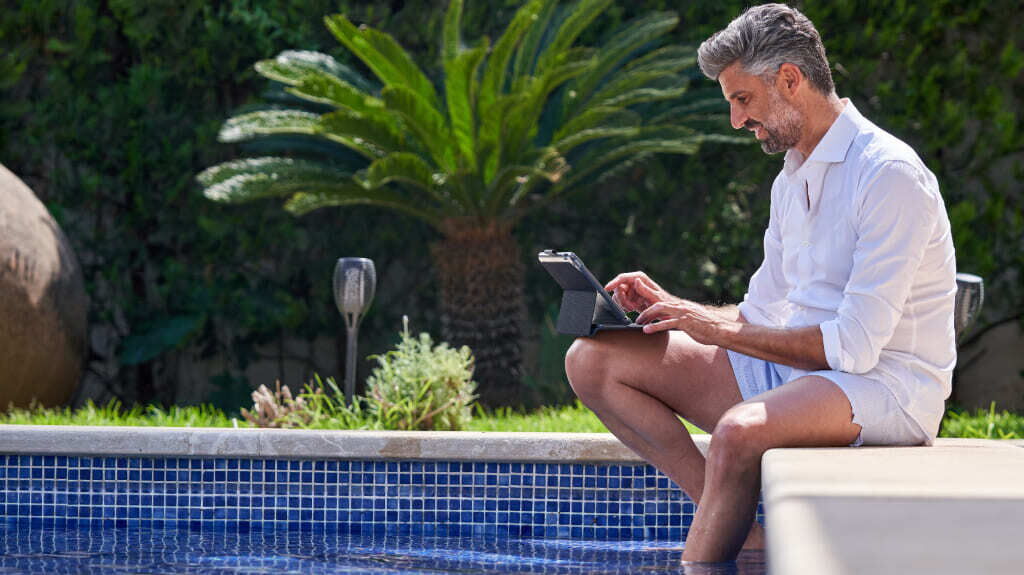
How to organise a workation in Italy without giving up comfort and privacy?
Navigate the article:
- What makes a villa suitable for a workation: the criteria that actually matter
- The best Italian destinations for a villa workation
- The Raro Villas properties best suited to a workation: a concrete selection
- How to structure the days: the method that works
The workation in 2026 is no longer an emerging trend: it is a structured reality. 67% of business travellers extended at least one business trip for personal travel in 2025, up from 43% in 2022. The boundary between holiday and remote work has dissolved for millions of professionals worldwide. The phenomenon no longer concerns only freelancers and digital nomads: it concerns managers, lawyers, consultants, creatives, anyone whose only real work tools are a laptop and a connection.
The problem is that a quality workation, one that genuinely allows you to work well and relax equally well, requires a type of accommodation that coworking spaces and hotels cannot fully provide: a private, quiet base with separate work and living spaces, reliable Wi-Fi and a context that does not distract at the wrong moments. For discerning, high-net-worth travellers, a private villa in Italy is the most natural fit for this kind of getaway.
Raro Villas features a selection of estates that align perfectly with this vision: residences with confirmed connectivity, spacious interiors, outdoor areas where you can work in the open air or switch off completely, and sufficient distance from urban centres to guarantee quiet during working hours. This guide explains how to organise a workation in Italy without compromise.
What makes a villa suitable for a workation: the criteria that actually matter
Not all villas are equal from a workation perspective. A romantic villa for a couple on honeymoon and a villa suitable for a professional who needs to join international calls every morning have very different requirements. Before choosing, there are four concrete variables to verify.
The first is connectivity: Wi-Fi present is different from Wi-Fi reliable enough for video calls. In Italy, fibre coverage in rural areas has improved significantly in recent years, especially in Puglia and Tuscany, but it remains a variable to verify before booking. Raro Villas provides this information for all properties and the team can check connection speed on request before booking.
The second is space separation: a villa with a single shared living area works for holidays, not for a mixed-group workation where some work and others relax. Properties with multiple spaces, dedicated rooms or independent annexes are ideal.
The third is the acoustic context: a villa in a tourist village with summer traffic is very different from a masseria immersed in the Pugliese countryside three kilometres from the nearest town. For a workation, quiet mornings during working hours are a non-negotiable requirement, not an optional luxury.
The fourth is the minimum stay duration: many properties accept weekly or bi-weekly stays, ideal for a structured workation. The Raro Villas team can negotiate longer durations on request for professionals seeking a base for 2 to 4 weeks.
The best Italian destinations for a villa workation
Not all Raro Villas destinations are equally suited to a workation. The choice depends on the type of professional, the season and the balance sought between work and leisure.
Puglia, particularly the Valle d'Itria and the Ostuni area, is the most balanced destination for a workation: the climate is excellent from March to October, connectivity in prestigious residential areas is reliable, and the distance from urban centres guarantees quiet without isolation. Restored masserias and trulli offer spacious, well-lit interiors perfect for morning work and territory exploration in the afternoon.
Tuscany—particularly Montalcino and Chianti—is the natural choice for those seeking a rich cultural backdrop and a landscape that fosters focus: rolling hills, quiet vineyards, and serene silence. It’s ideal for mid-length stays of 10 to 21 days during the shoulder season.
Sardinia, particularly in the Arzachena and Porto Cervo area, offers a different balance: work in the morning, sea in the afternoon. The most suitable period for a Sardinian workation is September, when property connectivity is fully operational, the sea is at its peak temperature and beaches have shed August's tourist pressure.
- Puglia, Valle d'Itria and Ostuni: ideal from March to October, guaranteed quiet, properties with multiple spaces
- Tuscany, Montalcino and Chianti: ideal from April to November, inspirational landscape, farmhouses with ample interiors
- Sardinia, Arzachena and Porto Cervo: ideal in September, warmest sea of the year, villas with panoramic terraces
- Salento, Lecce and surroundings: ideal for those who value urban energy close by, with the countryside as a private base
Read also: Puglia or Sardinia? How to choose the right destination for your exclusive villa holiday
The Raro Villas properties best suited to a workation: a concrete selection
Corte Kalia in Puglia is perhaps the Raro Villas portfolio property that best expresses the concept of a high-quality workation: restored trulli and villa with infinity pool, golf area with outdoor putting green and indoor Trackman simulator, included Wi-Fi, well-differentiated indoor and outdoor spaces, and 5 bedrooms for 10 to 12 guests. For teams looking to blend high productivity with wellness, it offers everything they could possibly need.
Tenuta Palù in Carovigno is a luxury villa with indoor and outdoor pool, lush gardens, 4 double bedrooms each with private bathroom, an independent annexe with heated indoor pool, alarm system and high-speed Wi-Fi across the entire property. The position, a short distance from the centre of Carovigno and 15 minutes from the Torre Guaceto natural reserve, guarantees access to services without sacrificing operational privacy.
Villa Ambrosini in Montalcino is the Raro Villas reference for the Tuscan workation: a stone villa with air conditioning, private pool and Wi-Fi, 6 bedrooms for 12 guests with a large ground-floor communal living area. The option of having a professional chef in the villa removes meal management during the most intensive working days, and the position in the Montalcino vineyards guarantees silence of exceptional quality.
Masseria Borgopietra in Ostuni, with 7 bedrooms, pool and 4 hectares of olive trees, is the choice for larger teams or extended families where only part of the group works remotely: the spaces are large enough to guarantee real separation between work and leisure areas.
For those travelling as a couple or alone and looking for a more intimate but equally curated base, Villa Amelia in Ostuni is a modern villa with an infinity pool, panoramic views over the Valle d'Itria, air conditioning and Wi-Fi in all spaces including the terrace, with utilities included in the price.
How to structure the days: the method that works
A workation almost always fails for the same reason: not having defined the temporal boundaries between work and holiday before leaving. Landscape and climate alone are not enough to guarantee productivity if the daily structure is left to improvisation.
The model that works best, confirmed by those who practise it regularly, is a three-block division:
- Morning (7:00-13:00): protected working hours in a dedicated space in the villa, with non-work notifications silenced. The outdoor terraces of Pugliese masserias in the morning hours, with raking natural light and absolute quiet, are among the most productive working environments Italy can offer.
- Early afternoon (13:00-15:30): lunch prepared by an in-villa chef or with produce from the morning's local market, a genuine device-free break.
- Afternoon and evening (15:30 onwards): pool, excursion, dinner out, exploration of the territory. Time completely free from any professional commitment.
This structure allows a full working week to be completed in five days, with Friday and the weekend dedicated entirely to the experience of the place.
To build a workation in Raro Villas destinations, including connectivity verification before booking and the organisation of additional services (chef, transfers, activities), the team is available via the contact form.
Read also: Golf, padel and sailing: how sport is changing the way people choose a villa in Italy
7 days in Valle d'Itria: a luxury itinerary of masserias, white villages and authentic experiences
Browse the article:
- Days 1 and 2: arriving in Alberobello and first breath of the Valle
- Days 3 and 4: Martina Franca, Cisternino and the culture of grilled meats
- Giorni 5 e 6: Ceglie Messapica, Ostuni e le masserie storiche
- Giorno 7: un'esperienza finale tra cantina, frantoio e campagna
Seven days in the Valle d'Itria are never quite enough, but they are sufficient to understand why this corner of Puglia has become one of Europe's most sought-after destinations. It is not just a matter of trulli or centuries-old olive groves, although the landscape has a painterly quality that international travellers recognise immediately. It is a place of rich layering: every town tells a different town, every masseria carries a history you can still sense in the air, every glass of Locorotondo DOC poured at sunset offers a taste of something timeless and distinct.
This itinerary is built for those who want to move through the Valle d'Itria at the right pace: slowly enough to absorb the details, carefully enough not to waste a single one of the seven evenings. Whatever your choice of sanctuary—whether a restored masseria, a historic trullo, or a boutique estate nestled in the countryside—the experience begins with an exceptional home. Raro Villas’ curated portfolio spans the entire valley, allowing you to craft this itinerary without a single compromise.
Days 1 and 2: arriving in Alberobello and first breath of the Valle
Alberobello is the natural entry point for those arriving from Bari or Brindisi airport. The town has been a UNESCO World Heritage Site since 1996 and its trulli are probably the most photographed architecture in southern Italy, but the risk of experiencing it as a purely tourist destination is avoided by choosing the right moment: the early morning hours, when the lanes of the Rione Monti are silent and the light bends between the limestone cones in a way that no photograph faithfully reproduces.
The first afternoon deserves a stop in Locorotondo, just a few minutes by car. It is one of the most beautiful villages in Italy, recognised with the Touring Club's Orange Flag for the harmony of its forms and the walkability of its historic centre. Its "cummerse", the distinctive houses with sloping roofs in two layers of limestone slabs, are different from the trulli but equally unique: you walk the lanes looking upward, where the rooftops create a geometry that changes at every corner. From the Locorotondo belvedere, the view across the Valle d'Itria on a clear day has no equal.
In the evening, dinner at EVO in Alberobello sets the perfect tone for the end of your first two days: just sixteen covers, an exclusive selection of low-intervention Apulian wines, and a menu crafted around twenty-five distinct extra virgin olive oil cultivars.
As for accommodation, Trullo Emmebi offers a panoramic pool, 5 suites and a direct view of the Valle d'Itria, with 10 beds ideal for groups or families. Alternatively, Trulli Pozzo del Geco in Locorotondo hosts up to 6 guests in a trullo complex with a private pool in the Cisternino countryside, the perfect choice for guests looking to fully immerse themselves in the authentic Itria Valley countryside.
Days 3 and 4: Martina Franca, Cisternino and the culture of grilled meats
Martina Franca holds an unrivaled title: the Baroque capital of the Itria Valley. Its historic heart revolves around the Basilica di San Martino and the Palazzo Ducale—a town that constantly surprises with the grandeur of its design and the serene silence of its hidden courtyards. The town hosts the Festival della Valle d'Itria every July, one of Italy's most important lyric opera festivals, and carries a cultural vitality that is perceptible even outside the season.
From a gastronomic standpoint, Martina Franca is where you taste capocollo DOP: sliced thin, paiOn the culinary front, Martina Franca is the definitive stop to taste authenticred with a glass of local wine, it is one of those products that embody a century-old tradition of meat curing and ageing. Local custom holds that you do not leave Martina Franca without having tried it.
Day three culminates in Cisternino, one of Italy's 100 most beautiful villages, where the bombette tradition has transformed the old town's butcher-grill shops (macellerie con fornello) into a nationally recognised gastronomic institution. Bombette (rolls of horse or veal meat filled with cheese, grilled over an open flame at the counter) are not street food in the conventional sense: they are a social ritual consumed standing up, at the counter, with an ice-cold beer and smoke drifting from the grills. It is difficult to find anything more authentic.
For these two days, Trullo Cielo in the Martina Franca countryside serves as your private sanctuary: a large trullo with an independent master suite, pool and a central position relative to the Valle's main villages. Trulli Itaka in Ceglie Messapica offers 4 rooms in two independent units with an organic vegetable garden and barbecue area, perfect for those who want to cook with the territory's own produce.
Days 5 and 6: Ceglie Messapica, Ostuni and the historic masserias
Ceglie Messapica, declared "City of Art and Land of Gastronomy," is the village that food lovers discovered before anyone else. Its whitewashed historic centre, with chianca-paved lanes and silent little squares, is the ideal setting for dinner at Cibus: a fifteenth-century convent, the kitchen rotates nearly 300 seasonal creations, podolico beef tartare, sagnapenta ragù and donkey stew in terracotta. Pugliese cuisine before it became an international trend.
Day five turns toward Ostuni—Puglia’s quintessential White City. Soaring above the Adriatic plain, its medieval skyline is one of the region’s most iconic sights. Yet Ostuni is far more than a postcard backdrop: the lanes of the ancient village, the Gothic-Romanesque Cathedral, the noble palaces converted into charming B&Bs, and the panoramic terrace from which the sea seems within reach even though it lies twenty kilometres away.
The sixth day is dedicated to Masseria Il Frantoio, just minutes from Ostuni: dinner in the outdoor courtyard with zero-mile cuisine, four estate extra-virgin oils and 300 seasonally rotating dishes. An appointment that must be booked in advance and that many Raro Villas guests consider the most memorable moment of the entire stay.
For these two days, Masseria Borgopietra is the reference choice: 7 bedrooms, 14 beds, pool and 4 hectares of centuries-old olive trees just 4 km from Ostuni. For those seeking the boutique hotel formula with included services, Masseria Lamagrotte by Raro Rooms offers rooms and suites in an 1800s masseria just 800 metres from the sea at Ostuni's Parco delle Dune Costiere, with breakfast and on-site assistance included.
Read also: Masseria weddings: the definitive guide to planning your perfect day in Puglia
Day 7: a final experience between winery, oil mill and countryside
The seventh day trades transit for true immersion. The Valle d'Itria produces two recognised DOC wines: Locorotondo DOC and Martina Franca DOC, white wines made from Verdeca and Bianco d'Alessano grapes. A winery visit with a tasting paired with local cheeses and Altamura bread is the most fitting experience for those who want to take something home that goes beyond a souvenir.
Alternatively, many of the Valle's historic masserias organise visits to the oil mill, where it is possible to witness the olive pressing process (in season, between October and November) or to taste extra-virgin oils from native cultivars. It is an experience that permanently changes the way you perceive Pugliese olive oil, and one that Raro Villas can organise on request for its guests.
Those who wish to structure the last day around a nature excursion can walk the Bosco delle Pianelle near Martina Franca: A protected nature reserve of Mediterranean maquis, carved by dramatic ravines and crisscrossed with marked hiking trails and the Grotta del Sergente Romano, believed to have been the hideout of Puglia's last brigand. A corner of the Valle d'Itria that few tourists know, and well worth the detour.
To explore the full range of villas, trulli and masserias available in the Valle d'Itria through Raro Villas and build a personalised itinerary, the team is available through the contact form for a tailored proposal based on your dates, number of guests and accommodation preferences.
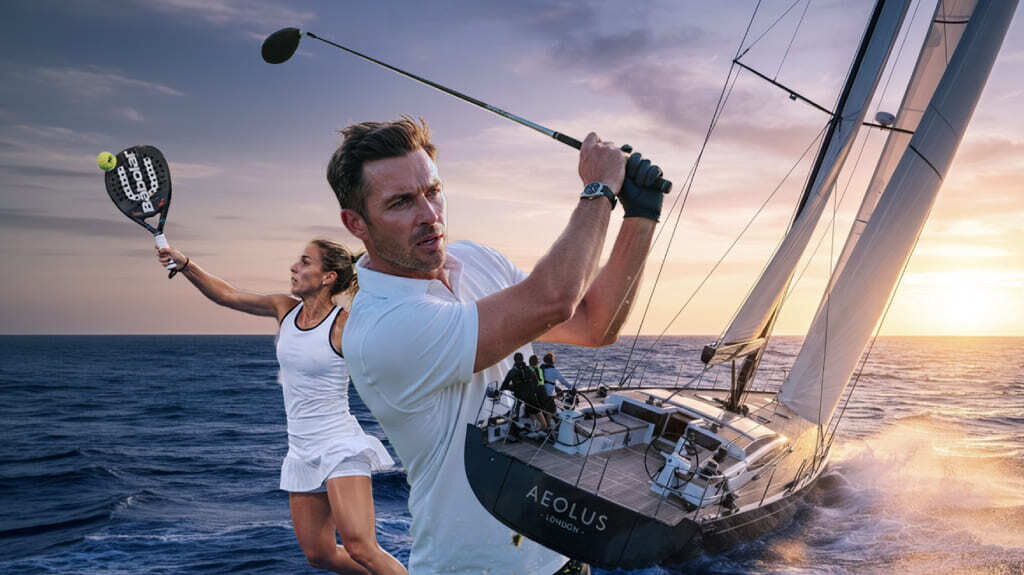
Golf, padel and sailing: how sport is changing the way people choose a villa in Italy
Explore the article:
- Golf: from private practice to the 18-hole course in Porto Cervo
- Padel: the sport of the moment enters villas and proximity facilities
- Sailing and Water Sports: When the Sea Is Part of the Villa
- Why sport is becoming a primary selection criterion for villa holidays
There’s a single metric that captures today’s evolution in high-end travel: affluent guests want far more than a private villa with a pool. They are looking for a villa that allows them to continue practising the sport that is part of their identity, without sacrificing the comfort of a private residence. Golf, padel and sailing are the three languages through which this change is expressing itself most forcefully.
Padel today counts over 35 million players worldwide, with courts growing by more than 15% in a single year to exceed 77,000 globally. Europe concentrates over 60% of players and about two-thirds of all courts in the world. Golf is living a new season of interest, driven by a younger and more international audience that combines it with quality accommodation experiences. Sailing, particularly in its more accessible form with catamarans and charter boats, has become an integral part of the premium coastal destination offer. Three sports, one common denominator: the search for active experiences within a holiday that never compromises on the quality of the residence.
Raro Villas curates some of Italy’s finest residences for guests looking to experience the country on a deeper level. Here is a verified selection, with sporting activities within the property or in the immediate vicinity.
Golf: from private practice to the 18-hole course in Porto Cervo
Golf was the first sport to structurally intertwine itself with the concept of a luxury villa. It is no coincidence that some of the most sought-after structures in the Raro Villas catalogue have made private sports practice a defining feature.
Corte Kalia is the most sophisticated example of this integration in contemporary Puglia: a complex of restored trulli and villa immersed in the Pugliese countryside, with an infinity pool, that includes a golf area with an outdoor putting green and an indoor Trackman simulator. The Trackman simulator is the same tool used by professionals on the world tour to analyse their swing: golf academy technology, available exclusively for the villa's guests. Corte Kalia accommodates up to 12 guests in 5 bedrooms and sits in a strategic position for reaching the Valle d'Itria villages and the Salento beaches.
Masseria Ficalindia, in the Lizzanello countryside just minutes from Lecce, offers a private-use golf practice area on a 4.5-hectare property immersed in the Salento countryside. The masseria has 5 en-suite bedrooms and a billiard room, for an integrated experience of sport, nature and culture: Lecce is 14 minutes away, the Adriatic beaches 21 minutes.
In Sardinia, the absolute reference for golf is Villa Pevero in Porto Cervo: an exclusive villa with pool and sea views, minutes from the 18-hole Pevero Golf Club, one of the most celebrated and scenic courses in the Mediterranean, designed by Robert Trent Jones on a landscape of pink granite, Mediterranean scrub and views over the Gulf of Pevero. For those who want to combine golf and the Costa Smeralda in the same stay, this is the most direct answer.
Read also: Puglia or Sardinia? How to choose the right destination for your exclusive villa holiday
Padel: the sport of the moment enters villas and proximity facilities
Padel is everywhere in 2026. This racquet sport has broken down the barriers for entry and accessibility to take over the world in a rally of fitness, fun and new communities. For decades, high-end sports travel was ruled by golf and tennis. However, the rise of luxury padel retreats at resorts across the globe is becoming hard to ignore.
What makes padel such a natural fit for private is the compactness of the infrastructure required: a padel court needs far less space than a tennis court and can be integrated even into medium-sized properties. Several Raro Villas properties are in the immediate vicinity of facilities with dedicated courts.
The most relevant case in the Fasano area is Borgo Egnazia, the reference resort for luxury Pugliese hospitality, which features three padel courts where guests can challenge their chosen opponent or book private lessons with expert instructors, ideal for both enthusiasts and those trying the sport for the first time. Raro Villas properties in the Fasano, Carovigno and Savelletri area have direct access to this sporting offer within a few kilometres.
For guests seeking an on-site padel court, Raro Villas can organise through its concierge service the booking of courts at the facilities closest to the chosen villa, curating a custom match schedule throughout the stay. It’s this level of service that transforms a villa holiday from a simple getaway into a bespoke active retreat.
Sailing and Water Sports: When the Sea Is Part of the Villa
Sailing is the third sporting pillar that is reshaping how travellers choose a villa in Italy. It does not necessarily mean owning a boat: it means having access to a reachable sea, to a property that can organise catamaran or motorboat hire, and to coves that in high season are accessible only by water.
In this context, Villa Vega at Portobello di Gallura is the Raro Villas property that best expresses this integration: two independent villas for 20 guests, with exclusive access to 3 km of coastline with white sand coves and catamaran service on request, alongside private chef, transfers and luxury car hire. The catamaran is not optional: it is the means by which guests reach the Portobello peninsula's coves that have no road access, some of the finest in the Gallura.
Every September, the Costa Smeralda hosts the Sardinia Cup, the international sailing regatta that transforms Porto Cervo into one of the most exclusive nautical settings in the Mediterranean. Those staying in a Raro Villas property in the area during that period experience the event from the inside, not as an outside spectator. Villa Essenza at Porto Rafael, with a panoramic view over the gulf and the La Maddalena islands, is one of the finest bases for exploring these waters: a seawater pool in panoramic position, equipped terraces, a 2,000 sqm garden, just 4 km from Palau and its port with connections to the archipelago.
Read also: What are the best alternatives to the Costa Smeralda? 5 lesser-known destinations in Sardinia
Why sport is becoming a primary selection criterion for villa holidays
The data driving this shift is clear: the profile of the luxury traveler has fundamentally changed. Those who choose a private villa today are often between 35 and 55, practise sport regularly, and consider the ability to play padel, get a round of golf in or take a catamaran not an optional extra but a necessary condition for choosing the property.
This has direct consequences for how properties are selected: a villa with a private putting green or with guaranteed access to a golf course within five minutes is worth, in the market's perception, significantly more than an equivalent villa without this feature. The same applies to padel and sailing.
- Golf: regular practice requires continuity: a Trackman simulator in the villa or an 18-hole course five minutes away are both decisive arguments.
- Padel: the social sport par excellence, it lends itself perfectly to a group holiday. The availability of a court nearby becomes a selection criterion on par with the outdoor kitchen or sea view.
- Sailing and water sports: the destination matters as much as the property. A villa with an included catamaran or direct sea access opens up experiences that a villa without this service simply cannot offer.
To build a stay that integrates sport and a prestigious residence in Raro Villas' Puglia and Sardinia destinations, the team is available via the contact page for a personalised proposal that includes the planning of the sporting activity alongside the choice of property.