Is Animeddas, the Masciari and the Dead: Italy's Halloween traditions that nobody tells international travellers
Navigate the article:
- Is Animeddas and Su Mortu Mortu: Sardinia was celebrating the dead before Halloween existed
- Fucacoste e Cocce Priatorje: Orsara di Puglia, the brightest night of the year
- The Night of the Masciari in Massafra: sorcerers, healers and ravines in the heart of Puglia
- Late October in a villa: why the All Saints' bridge is the best time to visit southern Italy
Before the 31st of October became a matter of online-ordered costumes and orange pumpkins, Italy already had rituals connected to the night of the dead that in some cases predate the Anglo-Saxon version of Halloween by centuries. These are not folklore reconstructed for tourists. They are living traditions, celebrated every year in the same squares, with the same sweets and the same fires, by communities that have never stopped observing them.
For international travellers who choose to visit Puglia or Sardinia at the end of October, these traditions represent something rare in contemporary cultural tourism: an authentic experience, rooted in the territory, found in no tour operator catalogue. This guide tells all three of them, with the Raro Villas properties closest to each.
Is Animeddas and Su Mortu Mortu: Sardinia was celebrating the dead before Halloween existed
The Sardinian tradition connected to the night of the dead is older than most visitors imagine. Is Animeddas, literally "the little souls", is the festival of the dead celebrated in the south of the island, in the Campidano, on the night between the 31st of October and the 1st of November. In the north, in the Sassari area and the Gallura, the same occasion takes the names Su Mortu Mortu or Sas Ànimas. In the Nuoro area it is called Su Mortu Mortu, and in Ogliastra Su Prugadoriu. Each name reflects a different local nuance, but the core is the same.
According to Sardinian popular belief, on the night of the 31st of October the gates of Purgatory open and the souls of the dead can return among the living, wandering through the places dear to them. Children move through the village streets knocking on doors and asking for gifts in the name of the souls of the dead: in return they receive dried fruit, pabassinas (traditional sweets made with raisins, almonds and spices), su pani de saba, ossu de mottu (the "bone of the dead", a sweet whose name says everything), chestnuts, pomegranates, almonds. The ritual structure is identical to trick or treat, but the roots are incomparably deeper.
What surprises scholars is that this tradition appears to have developed independently of the Celtic version of Samhain, and possibly even before the Catholic Church fixed the feast of All Saints on the 1st of November under Pope Gregory IV in the year 840. The prehistoric burial structures known as domus de Janas, small chambers carved into rock connected to one another like an underground village, are the physical context within which these beliefs developed.
Today the tradition is most alive in the interior villages of the island, but traces of these rites are found even in cities like Cagliari and Oristano. For those staying in a Raro Villas property in the Arzachena area, Villa Le Vele and Villa Vega at Portobello di Gallura are the bases from which to explore the Gallura villages where the Su Mortu Mortu tradition is still practised, half an hour's drive into the interior.
Read also: What are the best alternatives to the Costa Smeralda? 5 lesser-known destinations in Sardinia
Fucacoste e Cocce Priatorje: Orsara di Puglia, the brightest night of the year
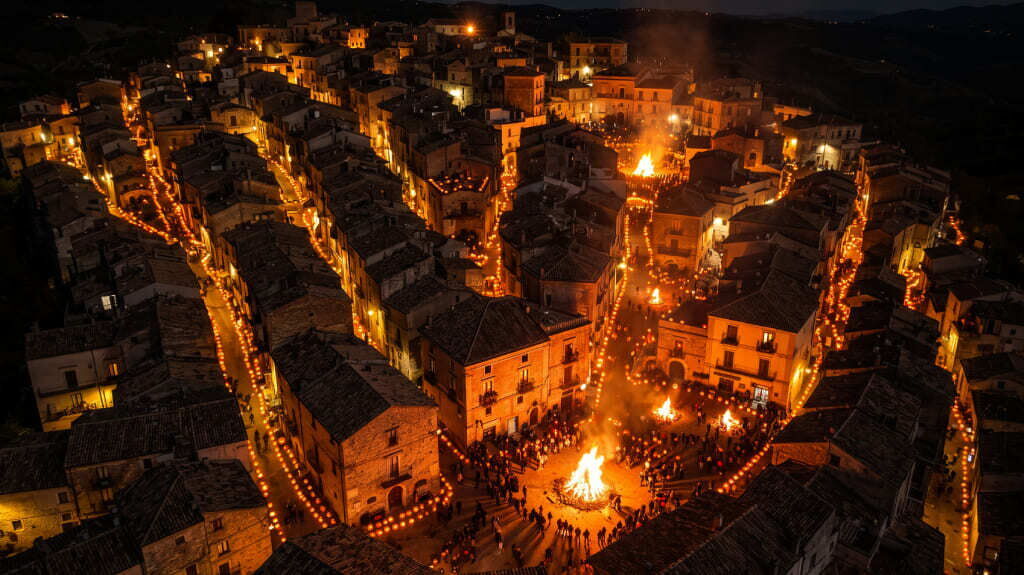
In Orsara di Puglia, a small village in the province of Foggia on the border with Campania, something happens on the 1st of November that has no equivalent in Italy. At sunset, every corner of the village is lit up: dozens of large bonfires are lit in the streets and squares, and hundreds of carved pumpkins with human features, each with a lit candle inside, are placed along every road and alley. The purpose is to light the way home for the souls of the dead, who according to tradition return to visit the places and people they loved.
It is called Fucacoste e Cocce Priatorje, "Bonfires and Heads of Purgatory", and whoever described it as "the brightest night of the year" captured the fundamental difference from Halloween: here, it is not darkness that is celebrated, but light. There are no witches, no demons, no frightening costumes. There is the shared fire, the ritual food, the memory of the dead as an act of love.
Food plays a central role. Around the bonfires, families and friends share the muscitaglia, known as the "wheat of the dead", a sweet made from cooked wheat enriched with pomegranate, walnuts and vincotto. The wheat of the dead symbolises rebirth. The connection between the agricultural cycle and the cult of the dead, which this tradition shares with many other ancient world cultures, remains perfectly legible in the ritual.
The 2025 edition took place on the 1st of November with pumpkin-carving workshops, a nocturnal Ghost Tour, conferences with anthropologists, street bands and food stalls. Orsara di Puglia sits in the province of Foggia, about two hours from the nearest Raro Villas properties in the Ostuni and Valle d'Itria areas. It is worth the journey.
The Night of the Masciari in Massafra: sorcerers, healers and ravines in the heart of Puglia
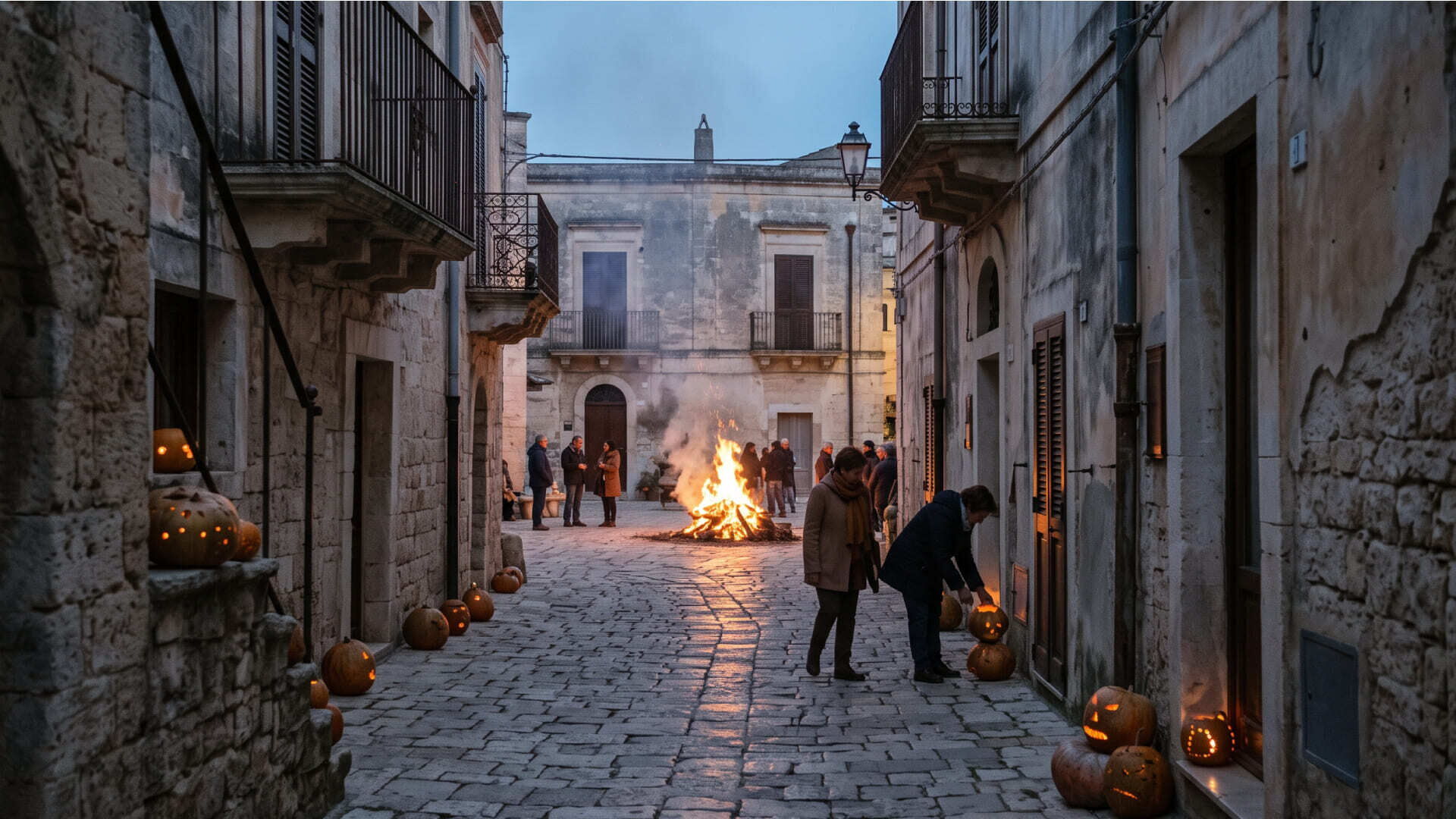
Massafra, in the province of Taranto, is one of Puglia's most mysterious cities: a labyrinth of rock-carved churches, ravines and cave dwellings that have earned it the nickname "the Thebaid of Italy". On the night between the 31st of October and the 1st of November, local legend holds that the dead wander through the village streets carrying a small flame on their finger, to illuminate the path between the world of the dead and that of the living.
But the tradition of the Masciari is even older and more layered. Since the Middle Ages, chronicles have passed down legends of sorcerers, healers and esoteric practices involving love potions, charms for happiness or money, made possible by the extraordinarily rich variety of medicinal herbs found in the ravine of the Madonna della Scala. The Masciari were figures on the boundary between folk medicine and witchcraft, an integral part of the cultural fabric of the territory, feared and respected in equal measure.
Every year on the 31st of October, in Massafra's Rione degli Ostinati, the historical re-enactment "Massafra in the Middle Ages on the Night of the Masciari" takes place: fire-eaters, beggars, acrobats, sorcerers, fakirs, jugglers, stilt-walkers, fortune-tellers, illusionists and falconers animate the streets of the historic centre in a living history that takes visitors inside the popular history of this territory.
Massafra is about 45 minutes from the Raro Villas properties in the Ostuni and Salento area, making a visit perfectly compatible with a stay at properties like Masseria Borgopietra or Corte dei Messapi.
Late October in a villa: why the All Saints' bridge is the best time to visit southern Italy
The period between the 31st of October and the 2nd of November has a quality of stay that few international travellers know. Temperatures in Puglia and Sardinia are still mild, averaging between 18 and 23 degrees. Beaches are empty but the sea still holds summer temperatures. Masserias and villas cost on average 40-50% less than the July and August peak. Restaurants work with care. And the All Saints' traditions add a cultural dimension that no other season can offer.
For those who choose a Raro Villas property as a base for the All Saints' bridge, the options in the Ostuni and Salento area allow combining, within just a few days, the Masciari re-enactment in Massafra, a visit to the trulli of Alberobello or the villages of the Valle d'Itria, the autumn festivals with harvest produce and the first olive oil pressing, and the still-warm beaches of the Ionian Salento.
- Masseria Borgopietra in Ostuni: 7 bedrooms, 4 hectares of olive trees, pool. Ideal base for the All Saints' bridge in the Pugliese Adriatic area
- Corte dei Messapi: 24 overnight places, multiple independent units, Valle d'Itria views. For groups who want to experience the whole territory
- Villa Vega at Portobello di Gallura: for those who want to experience Is Animeddas in Sardinia, with direct sea access and catamaran service on request
To check availability of Raro Villas properties for the All Saints' period and build a stay that includes local traditions, the team is available via the contact form.