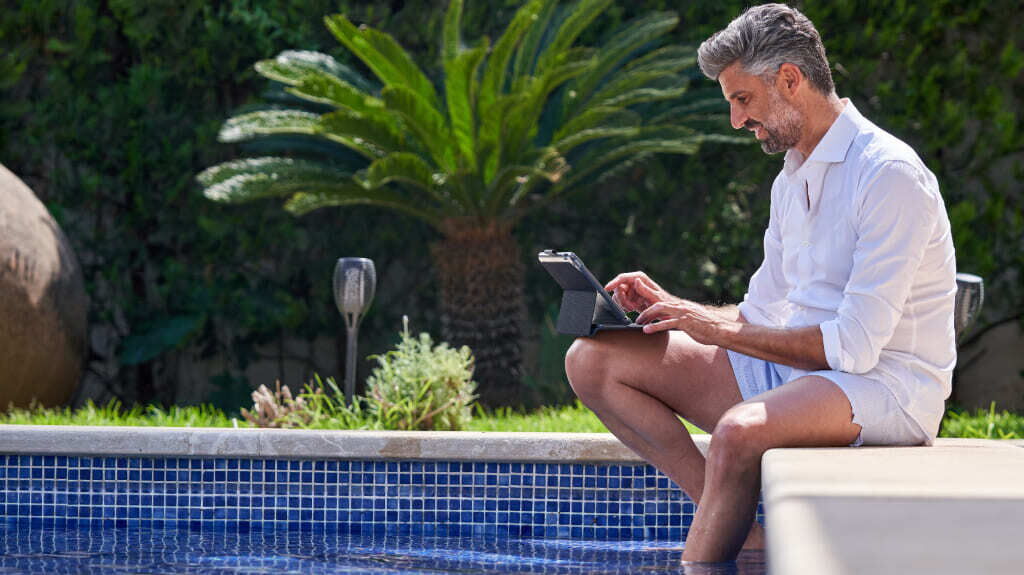
How to organise a workation in Italy without giving up comfort and privacy?
Navigate the article:
- What makes a villa suitable for a workation: the criteria that actually matter
- The best Italian destinations for a villa workation
- The Raro Villas properties best suited to a workation: a concrete selection
- How to structure the days: the method that works
The workation in 2026 is no longer an emerging trend: it is a structured reality. 67% of business travellers extended at least one business trip for personal travel in 2025, up from 43% in 2022. The boundary between holiday and remote work has dissolved for millions of professionals worldwide. The phenomenon no longer concerns only freelancers and digital nomads: it concerns managers, lawyers, consultants, creatives, anyone whose only real work tools are a laptop and a connection.
The problem is that a quality workation, one that genuinely allows you to work well and relax equally well, requires a type of accommodation that coworking spaces and hotels cannot fully provide: a private, quiet base with separate work and living spaces, reliable Wi-Fi and a context that does not distract at the wrong moments. For discerning, high-net-worth travellers, a private villa in Italy is the most natural fit for this kind of getaway.
Raro Villas features a selection of estates that align perfectly with this vision: residences with confirmed connectivity, spacious interiors, outdoor areas where you can work in the open air or switch off completely, and sufficient distance from urban centres to guarantee quiet during working hours. This guide explains how to organise a workation in Italy without compromise.
What makes a villa suitable for a workation: the criteria that actually matter
Not all villas are equal from a workation perspective. A romantic villa for a couple on honeymoon and a villa suitable for a professional who needs to join international calls every morning have very different requirements. Before choosing, there are four concrete variables to verify.
The first is connectivity: Wi-Fi present is different from Wi-Fi reliable enough for video calls. In Italy, fibre coverage in rural areas has improved significantly in recent years, especially in Puglia and Tuscany, but it remains a variable to verify before booking. Raro Villas provides this information for all properties and the team can check connection speed on request before booking.
The second is space separation: a villa with a single shared living area works for holidays, not for a mixed-group workation where some work and others relax. Properties with multiple spaces, dedicated rooms or independent annexes are ideal.
The third is the acoustic context: a villa in a tourist village with summer traffic is very different from a masseria immersed in the Pugliese countryside three kilometres from the nearest town. For a workation, quiet mornings during working hours are a non-negotiable requirement, not an optional luxury.
The fourth is the minimum stay duration: many properties accept weekly or bi-weekly stays, ideal for a structured workation. The Raro Villas team can negotiate longer durations on request for professionals seeking a base for 2 to 4 weeks.
The best Italian destinations for a villa workation
Not all Raro Villas destinations are equally suited to a workation. The choice depends on the type of professional, the season and the balance sought between work and leisure.
Puglia, particularly the Valle d'Itria and the Ostuni area, is the most balanced destination for a workation: the climate is excellent from March to October, connectivity in prestigious residential areas is reliable, and the distance from urban centres guarantees quiet without isolation. Restored masserias and trulli offer spacious, well-lit interiors perfect for morning work and territory exploration in the afternoon.
Tuscany—particularly Montalcino and Chianti—is the natural choice for those seeking a rich cultural backdrop and a landscape that fosters focus: rolling hills, quiet vineyards, and serene silence. It’s ideal for mid-length stays of 10 to 21 days during the shoulder season.
Sardinia, particularly in the Arzachena and Porto Cervo area, offers a different balance: work in the morning, sea in the afternoon. The most suitable period for a Sardinian workation is September, when property connectivity is fully operational, the sea is at its peak temperature and beaches have shed August's tourist pressure.
- Puglia, Valle d'Itria and Ostuni: ideal from March to October, guaranteed quiet, properties with multiple spaces
- Tuscany, Montalcino and Chianti: ideal from April to November, inspirational landscape, farmhouses with ample interiors
- Sardinia, Arzachena and Porto Cervo: ideal in September, warmest sea of the year, villas with panoramic terraces
- Salento, Lecce and surroundings: ideal for those who value urban energy close by, with the countryside as a private base
Read also: Puglia or Sardinia? How to choose the right destination for your exclusive villa holiday
The Raro Villas properties best suited to a workation: a concrete selection
Corte Kalia in Puglia is perhaps the Raro Villas portfolio property that best expresses the concept of a high-quality workation: restored trulli and villa with infinity pool, golf area with outdoor putting green and indoor Trackman simulator, included Wi-Fi, well-differentiated indoor and outdoor spaces, and 5 bedrooms for 10 to 12 guests. For teams looking to blend high productivity with wellness, it offers everything they could possibly need.
Tenuta Palù in Carovigno is a luxury villa with indoor and outdoor pool, lush gardens, 4 double bedrooms each with private bathroom, an independent annexe with heated indoor pool, alarm system and high-speed Wi-Fi across the entire property. The position, a short distance from the centre of Carovigno and 15 minutes from the Torre Guaceto natural reserve, guarantees access to services without sacrificing operational privacy.
Villa Ambrosini in Montalcino is the Raro Villas reference for the Tuscan workation: a stone villa with air conditioning, private pool and Wi-Fi, 6 bedrooms for 12 guests with a large ground-floor communal living area. The option of having a professional chef in the villa removes meal management during the most intensive working days, and the position in the Montalcino vineyards guarantees silence of exceptional quality.
Masseria Borgopietra in Ostuni, with 7 bedrooms, pool and 4 hectares of olive trees, is the choice for larger teams or extended families where only part of the group works remotely: the spaces are large enough to guarantee real separation between work and leisure areas.
For those travelling as a couple or alone and looking for a more intimate but equally curated base, Villa Amelia in Ostuni is a modern villa with an infinity pool, panoramic views over the Valle d'Itria, air conditioning and Wi-Fi in all spaces including the terrace, with utilities included in the price.
How to structure the days: the method that works
A workation almost always fails for the same reason: not having defined the temporal boundaries between work and holiday before leaving. Landscape and climate alone are not enough to guarantee productivity if the daily structure is left to improvisation.
The model that works best, confirmed by those who practise it regularly, is a three-block division:
- Morning (7:00-13:00): protected working hours in a dedicated space in the villa, with non-work notifications silenced. The outdoor terraces of Pugliese masserias in the morning hours, with raking natural light and absolute quiet, are among the most productive working environments Italy can offer.
- Early afternoon (13:00-15:30): lunch prepared by an in-villa chef or with produce from the morning's local market, a genuine device-free break.
- Afternoon and evening (15:30 onwards): pool, excursion, dinner out, exploration of the territory. Time completely free from any professional commitment.
This structure allows a full working week to be completed in five days, with Friday and the weekend dedicated entirely to the experience of the place.
To build a workation in Raro Villas destinations, including connectivity verification before booking and the organisation of additional services (chef, transfers, activities), the team is available via the contact form.
Read also: Golf, padel and sailing: how sport is changing the way people choose a villa in Italy